
Short answer: Ceramides are a family of lipids found in the skin’s outer layer. Together with cholesterol and fatty acids, they help organize the barrier that slows water loss and separates the body from the outside environment. A product that lists ceramides may support a moisturizing routine, but its finished formula matters more than the ingredient name alone.
Key takeaways
- Ceramides are structural lipids, not exfoliating acids.
- They work as part of a lipid system; the finished formula and regular use matter.
- A ceramide serum can add a light step, while a moisturizer usually does more of the sealing work.
- Read the full ingredient list and directions instead of judging a product by one featured ingredient.
Where ceramides fit in the skin barrier
The stratum corneum is the outermost part of the epidermis. It is often explained as bricks and mortar: flattened skin cells form the bricks, while lipids fill the spaces around them. Ceramides are a major part of that lipid matrix. Reviews of skin-barrier research describe ceramides working alongside cholesterol and free fatty acids to form organized layers that limit water evaporation and help control what passes through the surface.
That description is useful, but it should not turn into a promise that any jar with the word ceramide will repair every form of dryness or irritation. Researchers have found that the way ceramides are incorporated into a finished formula affects performance. Undissolved or poorly organized ceramides may not behave like a well-designed lipid system.
Ceramide serum or ceramide moisturizer?
The better format depends on the job you need the product to do. A ceramide serum is usually lighter and may fit between toner and moisturizer. A lotion or cream normally contains a broader mix of humectants, emollients, and occlusive ingredients, so it can reduce the dry, tight feel that follows cleansing.
| Format | Typical role | Best question to ask |
|---|---|---|
| Serum | Light hydration or a targeted layer | Will it layer comfortably under my moisturizer? |
| Lotion | Light moisture with an easy daytime finish | Is it enough for my climate and skin feel? |
| Cream | Richer moisture and more surface sealing | Does it feel comfortable without causing congestion for me? |
How to read a ceramide product label
Start with the full ingredient list. U.S. cosmetic labels generally list ingredients in descending order of predominance, with specific exceptions for low-level ingredients and color additives. You may see names such as Ceramide NP, Ceramide AP, or Ceramide EOP. You may also see cholesterol, fatty acids, glycerin, hyaluronic acid, squalane, or other ingredients that shape the formula’s texture and moisturizing effect.
Then check the directions and format. A rinse-off cleanser and a leave-on lotion do different jobs even when both mention ceramides. Finally, check the claims. “Supports the skin barrier” is different from treating eczema, dermatitis, or another disease. Persistent burning, cracking, swelling, or rash deserves medical advice rather than another round of product swapping.
Skin ceramides and topical ceramides are related, but not interchangeable
Your skin makes and organizes many ceramide species as part of normal barrier biology. A cosmetic formula supplies selected ceramides or ceramide-like ingredients from outside the skin. That does not mean the product simply pours a replacement barrier into place. The ingredients still need to be dispersed, delivered, and combined in a stable formula that feels comfortable enough to use consistently.
This distinction explains why an ingredient list is only the start of the evaluation. Two products can both list Ceramide NP and still differ in texture, the surrounding lipid system, packaging, preservation, and directions. Independent evidence about a finished formula is more informative than treating the presence of one INCI name as proof of a clinical outcome.
What a ceramide product can and cannot tell you
A serum or moisturizer can tell you its format, ingredients, directions, and cosmetic claims. It cannot diagnose why your skin feels dry or irritated. Weather, frequent washing, overuse of exfoliants, a new fragrance, a prescription treatment, or a skin condition can all produce similar surface symptoms.
Use a small set of observations: Does the formula reduce tightness? Does it sit well under sunscreen? Does it sting? Can you use it regularly without adding more steps to correct the previous step? Those answers are more useful than assuming a higher ceramide count is always better. If a rash, cracking, or itching persists, move the question out of the shopping aisle and into a clinical conversation.
A simple way to add ceramides
Keep the rest of the routine steady while you test the product. Cleanse gently, apply a light serum if you use one, then finish with moisturizer. In the morning, use sunscreen as the final skin-care step. Introducing several new products at once makes it harder to identify what helped or what caused discomfort.
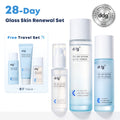
The ddg 28-Day Glass Skin Renewal Set combines toner, serum, and lotion formulas that include ceramide, peptide, and hyaluronic acid ingredients. Treat it as a coordinated hydration routine, not a medical barrier-repair program, and check each package for the current ingredient list.
Frequently asked questions
Are ceramides the same as hyaluronic acid?
No. Ceramides are lipids associated with the barrier’s structure. Hyaluronic acid is a water-binding molecule commonly used as a humectant in topical formulas. A product may contain both because they play different roles.
Can oily skin use ceramides?
Ceramides are not limited to dry skin. If you prefer a lighter finish, compare lotions or gel-creams and evaluate the whole formula rather than avoiding ceramides themselves.
How quickly should a ceramide product work?
A moisturizer can change surface comfort quickly, but there is no reliable universal countdown for ‘repair.’ Formula, frequency, climate, cleansing habits, and the reason for irritation all affect the result.
Sources and further reading
- PubMed: ceramides in skin-barrier function and formulation
- PubMed: clinical evidence for ceramide-containing formulations
- FDA Cosmetics Labeling Guide
- American Academy of Dermatology: choosing a moisturizer
This article is educational and does not diagnose or treat a skin condition. Product availability and ingredient lists can change; check the current product page and package before use.

