Skin Barrier Repair: How Long It Really Takes Week by Week
You're not alone. If your skin stings when you apply moisturizer, looks dull no matter what you do, or breaks out from products you used to tolerate — your barrier is asking for help. The good news? It does get better. Here's exactly what to expect, week by week, and what actually makes a difference.
Why This Happens: What a Damaged Barrier Actually Means
Think of your skin barrier like a brick wall. The corneocytes (skin cells) are the bricks. The lipids — ceramides, cholesterol, and fatty acids — are the mortar holding everything together. When the mortar breaks down, gaps open between the bricks. Water escapes (transepidermal water loss, or TEWL), and irritants, bacteria, and allergens slip in.
This is why damaged-barrier skin feels like everything is happening at once: dryness and oiliness, sensitivity and breakouts, redness and dullness. It's not that your skin is confused — it's that the wall has holes in it.
Common triggers include over-exfoliating with AHAs/BHAs, using high-pH cleansers, skipping moisturizer because you're "oily," prolonged retinoid use without barrier support, extreme weather changes, and even stress — which raises cortisol and slows lipid production.
The Common Mistakes That Slow Everything Down
Mistake 1: Adding more actives to "fix" the problem. When skin looks dull or textured, the instinct is to exfoliate. But exfoliating a damaged barrier is like sanding a wall that's already crumbling. You're removing the few bricks that are still standing.
Mistake 2: Switching to "barrier repair" products but keeping your stripping cleanser. If your cleanser leaves your face tight, no moisturizer in the world can fully compensate. The single most impactful change is often the simplest: switch to a gentle, low-pH cleanser. If you wear SPF or makeup daily, learn how to double cleanse without irritating sensitive skin.
Mistake 3: Expecting results in 3 days. The epidermis renews roughly every 28 days. While you'll feel relief sooner (less stinging, less tightness), the actual structural repair of your lipid barrier follows a biological timeline you can't rush. Patience is the hardest — and most important — active ingredient.
Mistake 4: Hydrating without sealing it in. Hyaluronic acid serums and watery toners pull moisture into the skin, but without an occlusive or semi-occlusive layer (like a ceramide lotion), that water evaporates right back out — sometimes taking even more moisture with it.
⚠️ Red Flag: If your skin stings when you apply plain water or a basic moisturizer you've used for years, your barrier is significantly compromised. Stop all actives immediately and focus on the three essentials: gentle cleanse, hydrate, seal.
What Actually Works: The Repair Protocol
① Ingredients That Build the Wall Back
Not all "hydrating" ingredients repair the barrier. Here's what the research supports:
- Ceramides — The mortar itself. Ceramides make up about 50% of your skin's lipid barrier. Applying them topically fills the gaps between skin cells, directly reducing TEWL. Look for products that list ceramide NP, AP, or EOP — these are the types identical to those found in healthy human skin.
- Skin-Identical Lipids — Cholesterol and fatty acids work alongside ceramides at an optimal ratio (often called the "3:1:1" ratio in dermatology literature). They ensure the ceramides you're applying are actually incorporated into your barrier, not just sitting on top.
- Panthenol (Pro-Vitamin B5) — A humectant that also has proven wound-healing and anti-inflammatory properties. It pulls water in while calming the reactive signals that make damaged skin feel hot and uncomfortable.
- Beta-Glucan — Derived from yeast cell walls, this ingredient is a stronger humectant than hyaluronic acid by some measures, and it also signals immune cells in the skin to shift from "attack mode" to "repair mode."
- Squalane — A lightweight, non-comedogenic oil that mimics your skin's own squalene. It forms a breathable seal without feeling heavy, making it ideal for barrier repair even on acne-prone skin.
② The Routine That Won't Overwhelm Your Skin
A barrier-repair routine isn't about doing more — it's about doing less, more consistently. Here's a minimal effective routine:
AM: Splash with water (or gentle cleanser if oily) → Hydrating toner or essence with panthenol → Ceramide lotion → Sunscreen (mineral, if chemical sunscreens sting).
PM: Gentle oil/balm cleanse (if wearing SPF or makeup) → Low-pH water-based cleanser → Hydrating toner → Ceramide lotion (a slightly thicker layer at night).
That's it. No serums, no actives, no exfoliants. For at least 2–4 weeks, you're in "maintenance mode" — and that's exactly where healing happens.
③ Lifestyle Factors You Can't Skip
Your barrier doesn't only exist in your bathroom. Sleep deprivation raises cortisol, which directly suppresses ceramide synthesis. A single night of poor sleep measurably increases TEWL the next day. Aim for 7+ hours — it's as much a skincare product as anything in a bottle.
Humidity matters too. If you sleep in dry, heated or air-conditioned air, consider a cool-mist humidifier. Even a 10% increase in ambient humidity can reduce overnight TEWL significantly. And drink water — not because it "hydrates your skin directly" (that's a myth), but because systemic dehydration absolutely shows up in your skin's ability to retain moisture.
The Timeline: Week 1 to Week 12
| Phase | What You'll Feel | What's Actually Happening |
|---|---|---|
| Week 1 | Less stinging when applying products; skin feels less tight after cleansing | Acute inflammation drops as you stop using irritants. TEWL begins to decrease. The "relief" is real — but the structural repair hasn't started yet. |
| Week 2 | Redness starts to fade; skin feels softer to the touch | Ceramides from your products begin integrating into the lipid bilayer. Inflammation markers continue to decline. You might notice fewer random breakouts. |
| Week 3–4 | Skin looks more even-toned; makeup sits better; you can go longer without moisturizer feeling tight | One full epidermal turnover cycle completes. The "new" skin cells have been produced in a lower-inflammation environment. Barrier function approaches ~70–80% of baseline. |
| Week 5–8 | Skin feels resilient — you can tolerate occasional exfoliation or a new product without immediate reaction | Multiple turnover cycles reinforce the lipid matrix. Your barrier's "tolerance threshold" rises. This is when you can cautiously reintroduce one active at a time — but go slow. |
| Week 9–12 | Full recovery for most people; skin looks plump, calm, and balanced | Lipid profile stabilizes. TEWL returns to normal range. Maintenance mode: continue ceramide support 1–2x daily to prevent re-damage. |
Note: This timeline assumes consistent daily care with barrier-supportive products and no reintroduction of actives before Week 4. If you have an underlying condition like eczema or rosacea, your timeline may be longer — and you should work with a dermatologist.
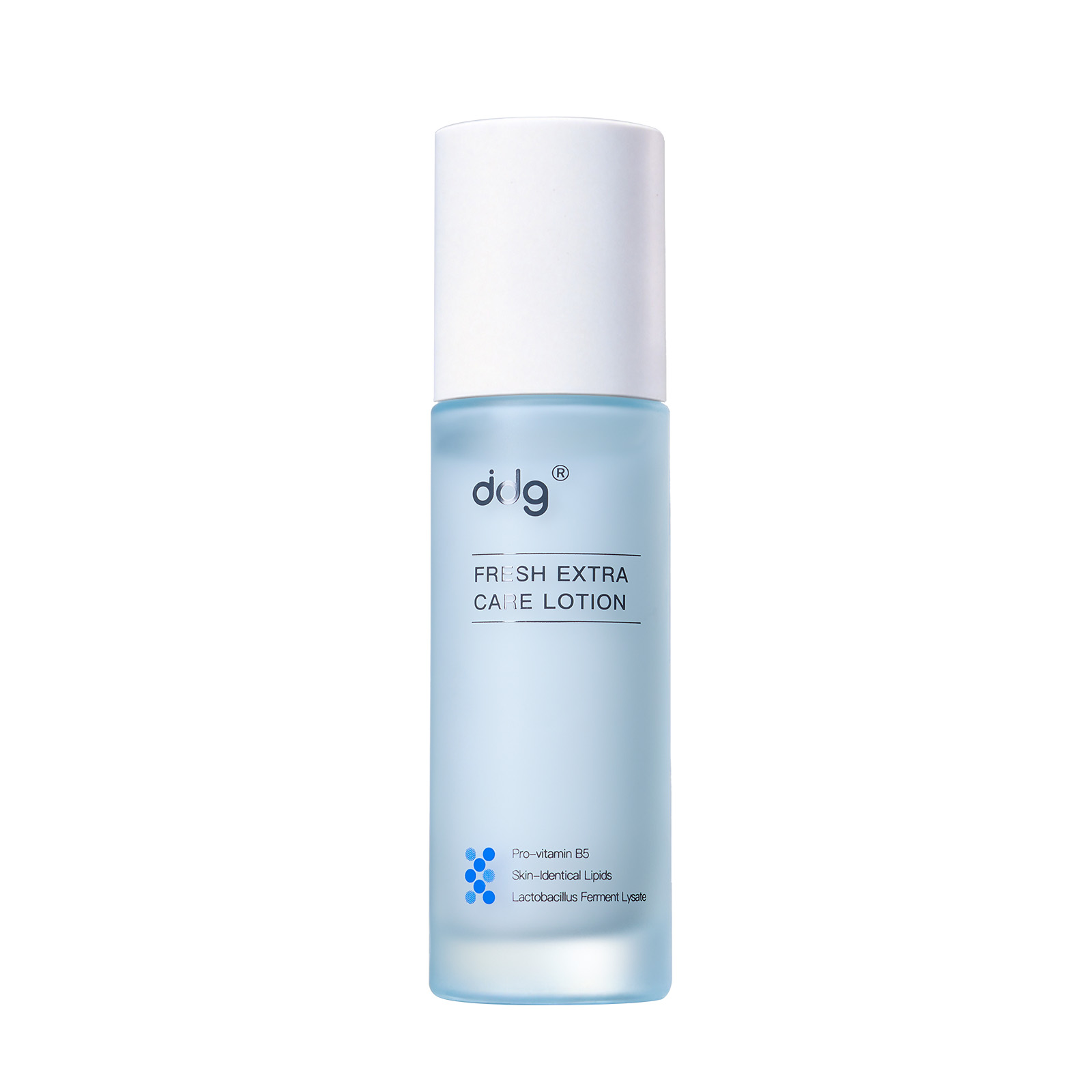
ddg Fresh Extra Care Lotion
Your daily barrier repair anchor — formulated with Ceramide and Skin-Identical Lipids to fill the gaps in a compromised barrier and lock hydration in place. Available in the 28-Day Glass Skin Renewal Set.

ddg 28-Day Glass Skin Renewal Set
A complete barrier-repair system: Toner (Pro-Vitamin B5 + Beta-Glucan), Serum (Hyaluronic Acid + Calmnerv CR), and Lotion (Ceramide + Skin-Identical Lipids). Three steps, one purpose — restoring calm, healthy skin in a single 28-day cycle.
FAQ: Barrier Repair Questions Answered
How do I know if my skin barrier is damaged?
Key signs include: stinging or burning when applying products you used to tolerate, persistent redness or flushing, increased sensitivity, dry patches alongside oily areas, dull or rough texture, and breakouts that don't respond to your usual treatments. If plain water or basic moisturizer stings, your barrier is significantly compromised.
Can I use exfoliants while repairing my barrier?
No — stop all exfoliants (AHAs, BHAs, physical scrubs, retinoids) for at least 2-4 weeks while your barrier heals. Exfoliating a damaged barrier removes the few healthy skin cells still standing. Once your skin stops stinging and feels resilient again, reintroduce one gentle active at a time, starting once weekly.
Is hyaluronic acid enough for barrier repair?
Hyaluronic acid is a humectant — it pulls water into the skin — but it does not seal that water in. Without a lipid-based moisturizer containing ceramides or fatty acids to lock hydration in place, the water can actually evaporate faster, worsening dehydration. Use HA under a ceramide moisturizer for optimal results.
How long should I wait before reintroducing actives?
Wait at least 4 weeks from the last sign of irritation (stinging, redness, tightness). When you reintroduce, choose one active at a time, use it once weekly, and watch for any reaction over the following 48 hours. If your skin tolerates it for 2 weeks, you can increase to twice weekly.
Does diet affect skin barrier repair?
Yes — essential fatty acids (found in salmon, walnuts, flaxseed) provide the building blocks your skin needs to produce ceramides. A diet consistently low in healthy fats can slow barrier recovery. Staying hydrated also matters: systemic dehydration reduces your skin's ability to retain moisture, regardless of what products you apply.
Can a damaged barrier cause acne?
Absolutely. When your barrier is compromised, bacteria and irritants can enter more easily, triggering inflammation that manifests as breakouts. This is called barrier-induced acne — and it typically worsens when you try to treat it with drying acne products. Barrier repair should come first.
Bottom Line
Your skin barrier didn't break in a day, and it won't fully heal in one either. But here's what matters: with the right ingredients (ceramides, skin-identical lipids), the right routine (gentle, minimal, consistent), and the right expectations (28 days for structural repair, up to 12 weeks for full resilience), you will get there. That tight, stinging, reactive feeling isn't your skin's personality — it's a temporary state. And temporary states change. For more guidance on sensitive-skin routines, browse our complete sensitive skincare guide collection.
At ddg, we formulate every product with barrier health as the foundation — because we know that great skin isn't about chasing perfection. It's about building resilience from the inside out. Our Fresh Extra Care line was designed to give sensitive, compromised skin exactly what it needs: science-backed ingredients in formulas that feel like nothing and do everything.